
Does CPM Matter? Yes, and No

Every few weeks someone asks me which platform is cheaper, and they point at the CPM column. Meta is at $5, TikTok is at $9, so Meta must be the better buy.
CPM does matter. It’s just not the number most people are looking at. The average CPM of a platform is one of the most misleading numbers in an ad account. It’s shaped by placements and audiences the platform switched on for you, and comparing those averages across platforms tells you almost nothing.
So the honest answer is yes and no. It depends on what you are averaging, what you compare it to, and what kind of ad the impression came from.
The Average Is Hiding the Junk
A platform-level CPM is a blend. It mixes the main feed, where people are actually looking at their phone, with partner placements inside other apps and mobile games. There your ad shows up between levels and gets closed as fast as possible. Those impressions are cheap for a reason: attention is low, accidental clicks are common, and the person on the other side is often not who you are trying to reach.
When a large share of your impressions runs there, your average CPM drops. On the dashboard the platform looks cheaper. Nothing about your buyers changed. You just bought more low-value views.
A simple example. Platform A has a feed CPM of $12 and a partner app CPM of $1.20, and 65% of its impressions go to partner apps. Its average comes out around $5. Platform B has a feed CPM of $10 and a partner app CPM of $3, and only 15% of its impressions go to partner apps. Its average is around $9.
On averages, A looks almost half the price. Look at the feed alone and B is cheaper. The “expensive” platform has the cheaper feed.
Your Placements Are Switched On for You
The mix isn’t an accident. It’s the default.
Open a new sales campaign in Meta Ads Manager and you get Advantage+ placements without asking for it: “We’ll automatically show ads in the places where people are likely to respond.” Under the settings, that’s 21 placements included, 0 excluded, and Audience Network ads set to expanded. Meta even adds new placements on its own. Mine came with a note that WhatsApp Status had been included “to help you reach new audiences.”

If you switch to manual placements and untick Audience Network, there’s one more box, “Allow limited spend to excluded placements”, and it’s ticked by default. It lets Meta spend up to 5% of the budget on each placement you excluded.
TikTok does the same. In a new sales campaign, the eligible placements come pre-ticked: TikTok, including search results, and TikTok Ad Network, which TikTok describes as “our worldwide network of nearly 400,000 apps.”
Google goes further, and this one surprises people because it’s a Search campaign. Both partner boxes are ticked and labelled “(recommended)”. Search Partners “can include hundreds of non-Google websites, Parked Domains, as well as YouTube and other Google sites.” The Display Network lets your search ads run “on relevant sites, videos, and apps across Google (like YouTube) and the Internet when you have leftover Search budget.” And the location starts on “All countries and territories.”

You set up an ad for people searching Google in one country. The defaults can send it to parked domains, apps and every market.
Your Audience Is a Suggestion
The same thing happens with audiences, and this part is less obvious.
On Meta, Advantage+ audience is on by default, and the screen splits your audience in two. Controls are the hard limits: “We won’t reach people beyond these settings, even with Advantage+ on.” That’s location, minimum age, exclusions and language. Everything else is a suggestion, and Meta says so plainly: “We’ll also reach people beyond any custom audience, age, gender and detailed targeting settings you apply when it’s likely to improve performance.”
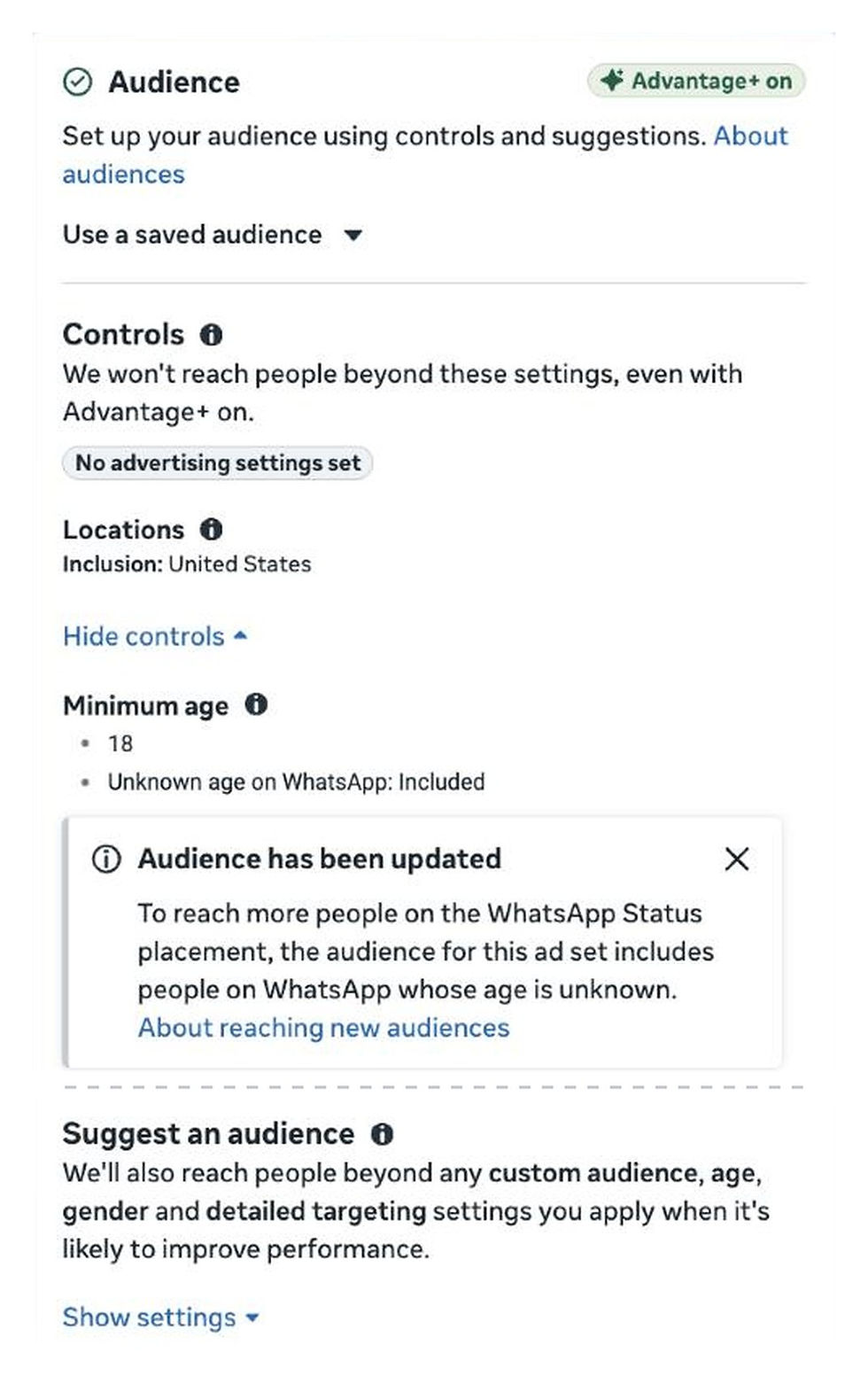
So you can set an ad up for women 25 to 44, and Meta can still deliver it to men and to people over 65. Even the minimum age has an exception. In the same draft, Meta had added a line under minimum age 18: “Unknown age on WhatsApp: Included.”
TikTok works the same way. A new ad group says “Automatic targeting is also enabled to reach people most likely to engage with your ads.” Only the audience controls are fixed. Age and the other audience settings go under “Automatic targeting guidance”, marked optional, with the line “Ad delivery to those audiences isn’t guaranteed.”

The setup screens also tell you this is the right way to do it. With every default on, Meta gives the campaign a score of 100: “You’re using our recommended setup.” Next to it: “Your audience is broad. Broad audiences can improve performance and reach more people likely to respond.” Google labels both partner networks “recommended”. Nobody is told the trade-off.
Broader reach usually means cheaper impressions, and that pulls the average CPM down again. Check your age and gender breakdown. Many advertisers are surprised by who they are actually paying to reach.
Why the Platforms Want It This Way
There are two reasons, and neither is about your results.
The first is the average. Partner networks, broader audiences and every age and gender all add cheaper impressions. They pull the platform’s average CPM down, so the cost looks like it’s falling, or looks cheaper than the competition. CPM is the number advertisers compare between platforms, and the defaults make it look good.
The second is attribution. Every extra placement and every extra person is another touch point. More touch points mean more chances for the platform to be part of a conversion it can claim, whether or not that impression did anything.
So the CPM you see is shaped by choices the platform made for you, not by what you are actually buying.
Compare Format to Format
That’s why I never compare CPM per platform. I compare it per format.
Feeds on Meta should be judged next to feeds on TikTok, because the user is doing the same thing in both: scrolling content on a phone in their hand. Partner networks should be grouped together across Google, Meta and TikTok, because they share the same problem. Search should be compared with search.
Some formats simply can’t be compared. Google Search and the TikTok For You feed are two different environments. In one, a person is typing what they want into a box. In the other, they are being entertained and weren’t looking for anything. Comparing those CPMs is like comparing the rent of a shop on a busy street with the price of a billboard on the highway. Both are real costs, but they buy different things.
The same goes for markets. A US CPM and a CPM blended across several countries are not the same number. Compare country to country.
Where CPM Really Matters
CPM matters most where the impression itself carries value. That’s visual advertising: social feeds, video and display. There the relationship with the customer starts before the click. People see your product, your colors, the way you present the brand, sometimes your face. Even if they keep scrolling, something stays. The next time they see you, you are not a stranger.
That changes how you read two platforms that look equal. Say Meta and TikTok feeds both deliver site visits at $1 each. On $1,000 of spend, both bring 1,000 visits. But one delivered 200,000 impressions and the other 100,000. Cost per visit says they are the same. They are not. One put your brand in front of people twice as often, and some of them will buy later without ever clicking that ad. You are seeding future customers, and those impressions have value.
Text search ads are different. A Google Search ad is mostly a line of text, with no image and no visual connection to the brand. If the user doesn’t click, there is very little left behind. On search, an impression without a click is worth a lot less, so the click is what you judge.
A simple rule: if the buying decision forms before the website visit, through the content people see and the brand they remember, weigh the impressions heavily. If the decision is made in the moment of the search, judge the click.
But this only works once the junk is out. Cheap impressions in a mobile game don’t build memory. The 2x example holds feed against feed, not feed against an average full of partner apps.
How to Read CPM Properly
Start with the placement breakdown, which every platform has. Look at the feed CPM, the partner network CPM and the search CPM separately, and see what share of your impressions each one takes. Then break it down by age and gender, and see how far delivery went beyond the audience you set.
Then compare like with like: feeds with feeds, partner networks with partner networks, search with search, in the same country. Decide which placements and audiences deserve your money and switch the rest off, including the limited spend box. And on visual formats, give the impressions their weight instead of judging only the click.
The Bottom Line
So does CPM matter? Yes, when you look at it by placement, audience and market, and especially on visual formats where every view builds memory. No, when it’s a single average per platform, shaped by defaults, compared against another platform’s average.
Segment your placements. Compare apples to apples. And stop making decisions on averages, because the average is usually where the junk hides.


Comments